Showing posts with label Sewing Tips. Show all posts

Friday, June 10, 2016

CB3200 Machine Labels - Cheat Sheets

Now that I am old, it has become easier and easier to forget some of my machine settings between uses.  I find myself wasting time looking things up that I should remember and I don't see the situation getting any better.

I created these labels from the Cowboy CB3200 manual, tips I have learned over time on setting thread tension, and some needle/thread/thickness recommendations from WizCrafts over at leatherworker.net, printed them on a clear inkjet label sheet, and affixed them to my machine.  

Now all of the information needed to match the needle and thread to the material thickness, to determine which direction in which to insert and thread the needle and bobbin, and to adjust the tension is right on the sewing machine.

Following are a couple of pictures of the labels on the machine and here is a pdf file of the labels that you can download and use to print your own.

Hope this helps.

Michael


Friday, October 3, 2014

How To Keep Track Of Type M Bobbins Loaded With Thread


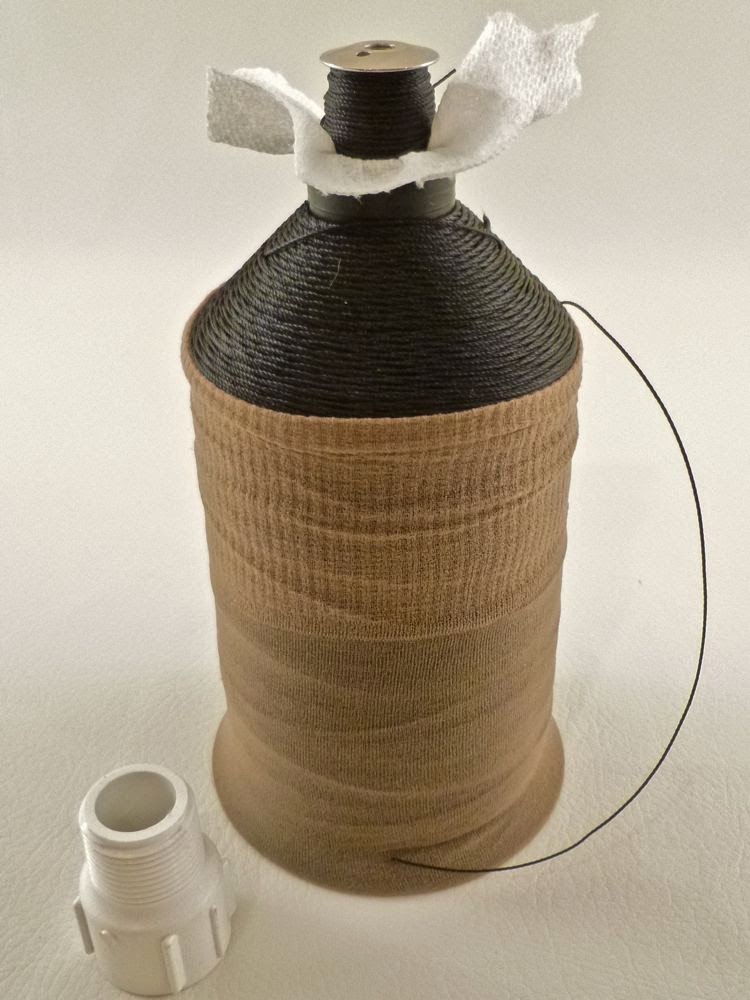
What to do with all of those pesky bobbins.  I've got multiple spools of thread in multiple colors and I like to keep the bobbin loaded with the same size and color thread with the matching spool.

Played with some wire hangers that slipped through the bobbin and hooked into the hole in the top of the spool, but they were unwieldy.

I then tried a piece of paper towel wrapped around the bobbin which allowed the bobbin to friction fit into the spool when stored, but the paper towel kept tearing.  Then replaced the paper towel with a barrel cleaning patch and it worked but the patch was a pain to keep track of.

Finally came up with a solution that is working for me.  You can take a 3/4" male thread to female slip PVC adaptor and slip it into the top of the spool (a little tight, but one could always sand the threads down a bit) and then drop the bobbin into the slip part of the adaptor and it won't fall into the spool.

The nice thing about this solution is that the adaptor can stay in the spool while threaded into the machine.

Attached are a few pictures.

Hope this proves helpful to someone.


Thursday, September 25, 2014

Needle Organizer for Leather Sewing Machine Needles

I needed to find a way to organize and keep track of my collection of leather sewing machine needles.

The problems were that the packets ended up all over the place, what to do with a needle that is still good but not new, and to identify which needle is currently in the machine.

I created this little needle wallet.  It fits the 10 pack of needles packets plus each pocket fits one additional needle.  In this way, a needle that has been used but not worn out can be easily identified and stored for future use.  I cut a plastic rod from a q-tip to insert in the pocket where the needle came from to identify which size is currently in the machine.  I suppose one could use different colored rods to identify needles being used in multiple machines.

Hope this helps.

Note the Extra Needles and the Blue Rod


New Automatic Bobbin Winder For Cowboy CB3200


I don't like the bobbin winder on the Cowboy CB3200 so decided to come up with an alternative.  The problem with a typical commercial sewing machine bobbin winder on a machine set up for leather is that it winds while the machine is engaged in stitching or, if not stitching, the stitching mechanism is running. Leather machines run rather slow and it takes too long to wind the bobbin and it seems like a lot of extra wear and tear on the machine.  Also, if left unattended, the bobbin doesn't wind with the thread evenly distributed on the bobbin spool.

I looked at several dedicated bobbin winders and found the Luis Sew model on ebay for $35 new including shipping.  This machine typically sells for $80 so I snapped it up.

Upon running it for the first time, I discovered that there is no speed control and the thing runs at warp nine... no control of the thread winding.  The tension discs are also too close to the bobbin which leads to uneven winding on the bobbin spool.

I decided to install a PWM (pulse width modulator) speed control which can be had for around $10.  The advantage of a PWM is that it maintains full torque while reducing the speed of rotation.  It also doesn't heat up the motor like a typical fan-type dimmer switch.

The machine also has a lot of vibration which creates excessive noise during operation.  I decided to make a new wider platform from 1/2" 9-ply baltic birch plywood.  I also mounted the motor on rubber washers.  The unit is now virtually silent.

So now the unit runs quietly, there is no vibration, the speed is variable down to zero RPM.  I can help the winding process manually to keep the threads winding evenly; it winds pretty well unassisted.  I have added nylon knee-high stockings to all of my spools of thread to keep them feeding consistently as well.

This unit works on type M, as well as residential type bobbins.

Hope this helps anyone looking for a better bobbin winding solution.

Here are some photos of the finished product.

Scroll to the end for Links to products discussed in this article.


The control knob on the top is the PWM.